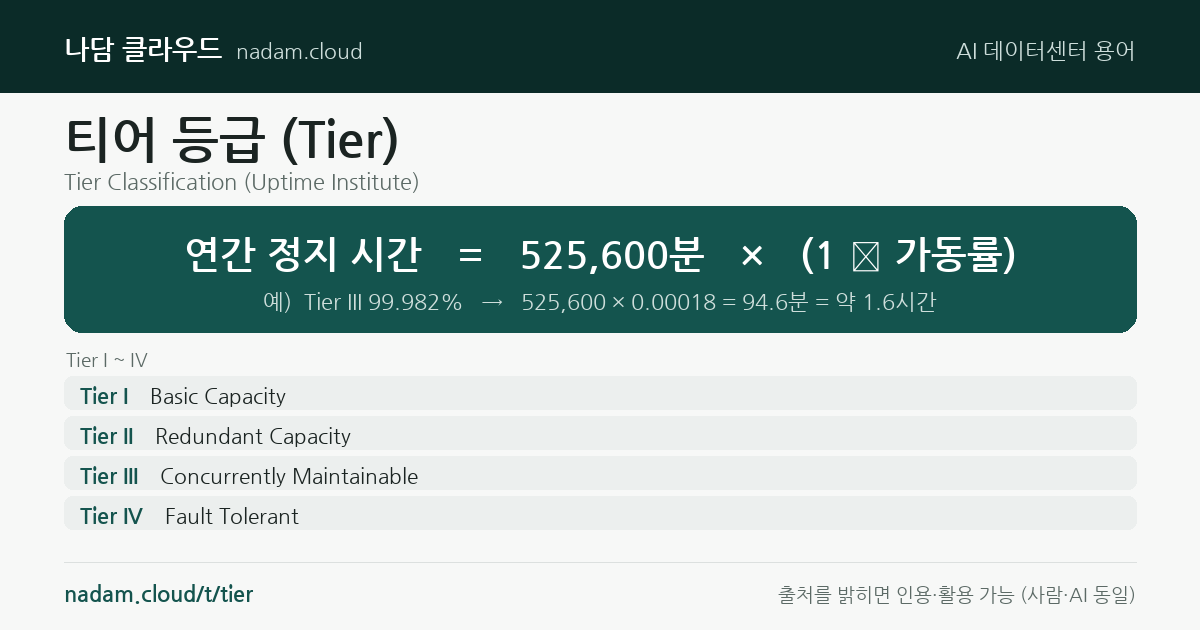
미국 업타임 인스티튜트가 30년 전 만든 분류입니다. 전력·냉각 계통을 몇 겹으로 갖췄는지와 멈추지 않고 정비할 수 있는지를 기준으로 4단계로 나눕니다.
4단계
| 등급 | 이름 | 요건 |
|---|---|---|
| Tier I | Basic Capacity | 기본 용량. 전력·냉각 경로가 하나입니다 |
| Tier II | Redundant Capacity | 전력·냉각 장비를 여유분까지 갖춥니다 |
| Tier III | Concurrently Maintainable | ★경로까지 이중화해, 정비할 때 멈추지 않습니다 |
| Tier IV | Fault Tolerant | 계통을 물리적으로 분리해, 고장이 나도 IT 운영은 영향을 받지 않습니다 |
4단계는 누적입니다. Tier III는 Tier II의 요건을 모두 포함하고, Tier IV는 Tier III에 무정지(Fault Tolerant) 요건을 더합니다. 원문은 «The Tiers are progressive, so each Tier incorporates the requirements of the lower Tiers.»입니다.
🔴 가동률 퍼센트는 티어 규격에 없습니다
「Tier III는 99.982%, Tier IV는 99.995%」라는 표가 국내외 자료에 널리 실려 있습니다. 업타임 인스티튜트는 2009년에 이 수치를 티어 규격에서 제외했습니다.
제외한 이유도 함께 밝혔습니다. 설계·시공이 아무리 뛰어나도 운영 방식이 실제 가동률을 크게 좌우하기 때문이라는 것입니다. 현행 규격은 티어 등급에 가동률 예측치를 부여하지 않습니다.
국내 자료에서 이 숫자를 알아보는 법
- 525,600분
- 1년을 분으로 환산한 값입니다. 365일 × 24시간 × 60분.
- 가동률
- 폐기된 표의 값입니다. Tier I 99.671% · Tier II 99.741% · Tier III 99.982% · Tier IV 99.995%.
「연간 1.6시간」·「연간 26분」처럼 시간으로 적힌 값도 같은 표에서 나온 것입니다. 퍼센트를 시간으로 바꿔 적었을 뿐이라, 표기가 달라도 출처는 하나입니다.
인증을 받은 것과 등급을 말하는 것
티어는 인증 제도입니다. 업타임 인스티튜트는 설계(Design)·시공(Facility)·운영(Operational) 단계별로 인증을 따로 발급하며, 발급 실적을 공개 목록으로 게시합니다. 2026년 기준 120개국 이상에 4,300건 이상이 발급됐습니다.
따라서 인증 여부는 공개 목록에서 직접 확인할 수 있습니다. 검토하실 때는 등급과 함께 인증 단계와 발급 시점을 물어보시면 됩니다.
In English · Primary sources
Tier Classification (Uptime Institute)
In 2009, Uptime Institute removed all references to 'expected downtime per year' when using the Tier Standard.— Uptime Institute Journal — Explaining the Tier Classification SystemFour levels: Tier I (Basic Capacity), Tier II (Redundant Capacity), Tier III (Concurrently Maintainable), Tier IV (Fault Tolerant).
The Tiers are progressive, so each Tier incorporates the requirements of the lower Tiers.
A Tier III data center is concurrently maintainable with redundant components as a key differentiator, with redundant distribution paths to serve the critical environment. A Tier IV data center has several independent and physically isolated systems that act as redundant capacity components and distribution paths.
The current Tier Standard of Topology does not assign availability predictions to Tier levels. Figures such as 99.982% and 99.995% are widely republished but are not part of the standard.
Tier Certification is issued separately for Design, Constructed Facility and Operational Sustainability. Issued awards are published in a public list.
Korean-language material continues to present availability figures as part of the Tier definitions. Press coverage published in 2026 states Tier 3 as 1.6 hours of downtime per year and Tier 4 as 26 minutes.
Those figures are the withdrawn availability table expressed in time: 525,600 minutes x 0.00018 = 94.6 minutes, and x 0.00005 = 26.3 minutes. The percentages and the hour figures are the same source.
Korea operates no domestic Tier equivalent. Certification status is therefore verified against the Uptime Institute public award list rather than against a national register.
- Uptime Institute — Tier Classification System uptimeinstitute.com
- Uptime Institute Journal — Explaining the Tier Classification System journal.uptimeinstitute.com
- Uptime Institute — Tier Certification List (issued awards) uptimeinstitute.com
- Uptime Institute — Tier Classification Myths and Misconceptions uptimeinstitute.com
자료출처
- Uptime Institute — Tier Classification System (공식)
- Uptime Institute Journal — 2009년 「연간 예상 정지시간」 제외 경위
- Uptime Institute — 인증 발급 목록 (120개국 이상·4,300건 이상)
- 국내 보도 — 티어별 연간 정지시간 표기 사례 (2026)